
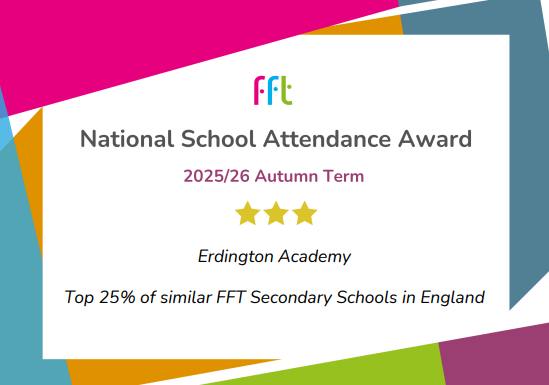
Erdington Academy has received another national award after pioneering innovative ways to drive up the attendance of its students.
The academy has been recognised for being in the top 25% of similar schools across England by FFT Aspire.
FFT Aspire, which provides data on schools and pupil progress, is used by more than 16,000 schools, multi-academy trusts and local authorities across the country.
Erdington Academy was also awarded a Bronze Award for attendance in 2025 and are now being assessed for the Silver Award.
Kathryn Wright, Vice Principal for behaviour and ethos, said: “In the last year we have reduced the number of students who are persistently absent by more than a third, and we have also improved SEND attendance by almost 3% which is wonderful.”
These improvements come after a persistent campaign by Erdington staff to check in on absent students.
Mrs Wright explained: “We call everybody who’s absent, even calling parents of children who are in hospital daily to check on how they are.”
 Erdington Academy has also been focusing on incentivising and rewarding good attendance within the school.
Staff monitor each student’s attendance using a band system, with children being celebrated every time they move up a band. There are awards for each 100% attendance week and even a special badge awarded to students with 100% attendance each term.
Alongside these in-school initiatives, Erdington’s ongoing partnership with the mentoring company MW Impact has brought support right to students’ doorsteps.
Founded by former pro-footballer Marlon Walters, MW Impact’s mentors have become a fixture of life at Erdington Academy and have been dedicating their time to supporting children struggling with their attendance.
The school trialled a project where MW mentors went to the homes of five students identified as being severely absent, supporting families with maintaining regular routines, helping them get ready for school in the mornings and motivating them to be in school and engage with their learning.
Mrs Wright said: “It takes a long time for the team to lay a groundwork with the parents to a point where they are trusted and allowed into homes, but it’s great for teaching students the importance of routine and structure.
“The trial had a success rate of 60%, which we’re really proud of. We managed to lift two students out of severe absence completely, and from the support they’ve managed to maintain good attendance themselves. We know as teachers and from past results the first key to success in GCSEs is strong attendance, so we are delighted that the Trust has agreed to support us rolling out the strategy further to support a greater number of students and their families.
“Attendance data for one student went up from 48% attendance to 78%, which is a massive achievement!”
Both Erdington’s internal staff and external partnerships have played a big role in increasing student attendance.
The attendance, pastoral, SEND and safeguarding teams meet weekly to discuss strategies for individual cases, and the school also has developed a close relationship with Pupil Disability Support Services and the team at Birmingham Children’s Hospital, helping the attendance drive extend beyond the school itself.
Mrs Wright said: “The team are fabulous. Every single one of them brings something unique to the table, and over time they’ve had a real impact.”
Additionally, partnerships with employers within the local community have enabled Erdington students struggling with the typical 5-day school week to enter alternative education provisions alongside reduced school hours.
Mrs Wright explained: “We work with a company called Making Learning Work which introduces students to employers who can support them with developing practical skills – for example, we have students working in a childcare environment or in a garage learning mechanics.
“Good attendance has a big impact on GCSE grades and academic achievement in the long-term, so it’s important in that sense, but school is also a secure place with routine, structure and expectations – something which is really important to developing young minds.”